


Lesson 2) Under the Sea! (Little Mermaid)
Very excited to hand over the next lesson to Professor Cattercorn, who has not only kindly agreed to write on The Little Mermaid and share her intimate knowledge of mermaids with you, but has also willingly and patiently allowed me to contribute my own thoughts to the lesson (though you won't be able to tell where I insert myself)!
In today's lesson, you'll also hear from two other professors: our Defense Against the Dark Arts Professor, Melanie Silvers, as well as our new Co-Mythology professors, Belle Aretina and Professor Rubedo. Professor Silvers is spearheading the Auror Studies Track course (https://www.facebook.com/groups/HiHAurorStudies/) which includes the Auror Skills Training course (https://www.facebook.com/HiHAurorSkillsTraining?fref=ts). If you're interested in becoming an Auror, be sure to contact Professor Silvers. If you're interested in pursuing Mythological Studies (https://www.facebook.com/HiHMythologicalStudies) be sure to contact Professor Aretina or Headmaster August Rubedo.
Today's film screening will occur here: http://www.watch2gether.com/rooms/hihdisneyscreeningroom-alh65kcv8x3pdecy.
For those of you taking Care of Magical Creatures (https://www.facebook.com/hihcomc), I have no doubt you will appreciate the lesson as well as the assignments. On with the show!
EH
Lesson 2: Under the Sea! (The Little Mermaid)
Welcome everybody to the second installment of Disney Lit Week! For those of you who have not yet had me, I am Professor Cattercorn, the Care of Magical Creatures Co-Professor. I am so excited to be teaching this lesson and I can’t wait to get started.
As some of you may have already deciphered from the lesson title, today we will be discussing "The Little Mermaid". The first version of "The Little Mermaid" was penned by Hans Christian Andersen in 1837, but we will be focusing more on the film version (released in 1989). If you haven’t seen the film or read the story, I urge you to do so as they are both classics. While Andersen’s version is much more tragic than its Disney counterpart, it is still beautifully written.

Synopsis
Although the Muggle film centers on the story of a 16 year-old mermaid named Ariel who is one of seven sisters, all raised by their father, King Triton, the film opens with a ship, Prince Eric, and a rather sea-sick looking Grimsby. After Prince Eric remarks on how it’s a perfect day to be at sea, one of the ship’s sailors echoes this sentiment, asserting that King Triton, the “ruler of the merpeople”, must be in a good mood. While Grimsby dismisses the talk to be “nautical nonsense”, Prince Eric appears captivated by the sailor’s tale. Before the camera shifts to the sea, we hear the sailors sing,
"Look out, lad, a mermaid be waiting for you
In mysterious fathoms below."
Unlike Anderson’s story, Disney’s film begins with humans, as a type of narrative dichotomy between fictional “Tales of the Sea” and the “real” lives of merpeople, as if to say, why yes, merpeople are real like you and me!
When we finally make our way "down to the sea", we discover that merpeople not only exist, but also have a distinct political structure: a king, princesses, a royal court, and even a royal court composer, who is none other than (Horatio Thelonius Ignatius Crustaceus) Sebastian!
 King Triton’s “little Ariel”, we learn before we meet her, possesses an exceptional musical gift (yet has a tendency not to show up for rehearsals). In this sense, she is already unique; her sisters, who seem to be more interested in appearances and performance, are content with their current lives and don't ask questions. Unlike her sisters, Ariel, the youngest and most stubborn of the seven, has an unshakeable fascination with humans and the world beyond the sea--and a tendency to disobey her father’s orders!
Although we do not find out the full extent of King Triton’s intense aversion to the world above, we learn in The Little Mermaid III that Ariel’s mother lost her life on account of a pirate ship (a plot that is echoed in ABC’s Once Upon a Time, except in relation to Ursula--who in this version was once a mermaid--and her father is Poseidon, God of the Sea).

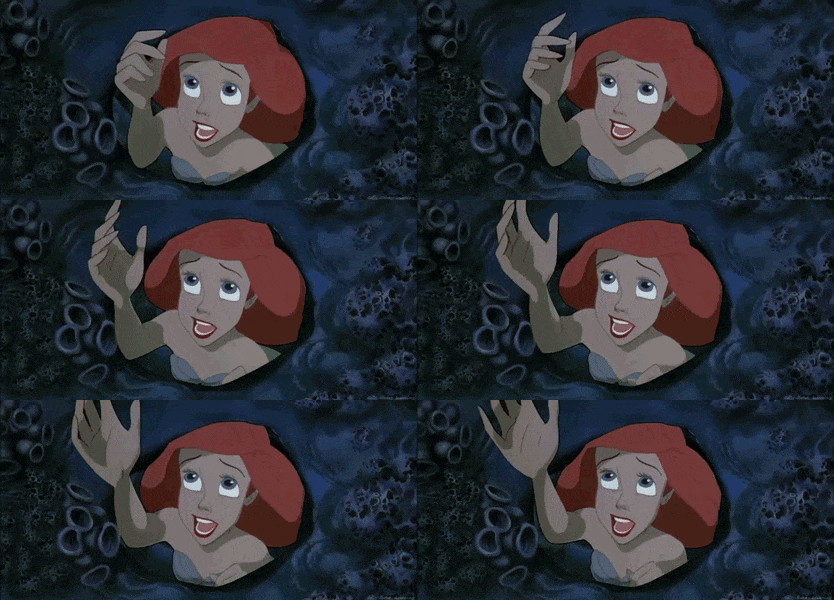
The "longing" of Andersen's Little Mermaid is conveyed through Ariel's singing of "Part of Your World":
Through the song, Ariel suggests that she is willing to do anything to make her dream possible (and Andersen's Little Mermaid certainly does experience both pain and suffering, as we'll discuss later on). The song sets up an excellent contrast between Ariel's material possessions (the physical world) and her desire for "more" (the spiritual world). In Andersen's text, what the Little Mermaid truly wants, more than even the love of a human, is to have a soul. According to her grandmother, mermaids do not have souls, but exceptionally long lives (upwards of 300 years); in order to gain a soul, however, a mermaid must marry a human being and share part of their soul in order to go to heaven.
 In Disney's version, Ariel's "more" is the love that will allow her to ascend (or transcend, in Andersen's case) to the human world. While Disney's Ariel is successful in her quest, Andersen's Little Mermaid, sadly enough, is not. Although Andersen's Little Mermaid does not win the heart of the Prince, through her sacrifice and unwillingness to allow any harm to come to him, she ascends to the heavens with her newly acquired soul.
While Andersen's text involves the Little Mermaid discovering the Prince's ship on the day of her fifteenth birthday, Disney's version depicts the moment after Ariel finishes singing "Part of Your World", when she sees the shadow of a ship, and its fireworks, pass overhead.
 Hiding on the side of the ship (though of course Eric's dog, Max, ‘sniffs’ her out), she notices a party being held for the young Prince Eric, whom Ariel quickly becomes infatuated with. While certainly quite handsome, we learn from Prince Eric’s conversation with “Grim” that he’s not much into the “material world” (hates the statue made in his image!) and he seems to be, like Ariel, looking for “more”. We also learn that he didn’t end up “falling for” the never seen Princess of Glower, a stark contrast to Andersen’s text.
 In Andersen's version, after the shipwreck, the Prince (unnamed, like the Little Mermaid), believes he is rescued by a young temple maiden, since the Little Mermaid cannot reveal herself.
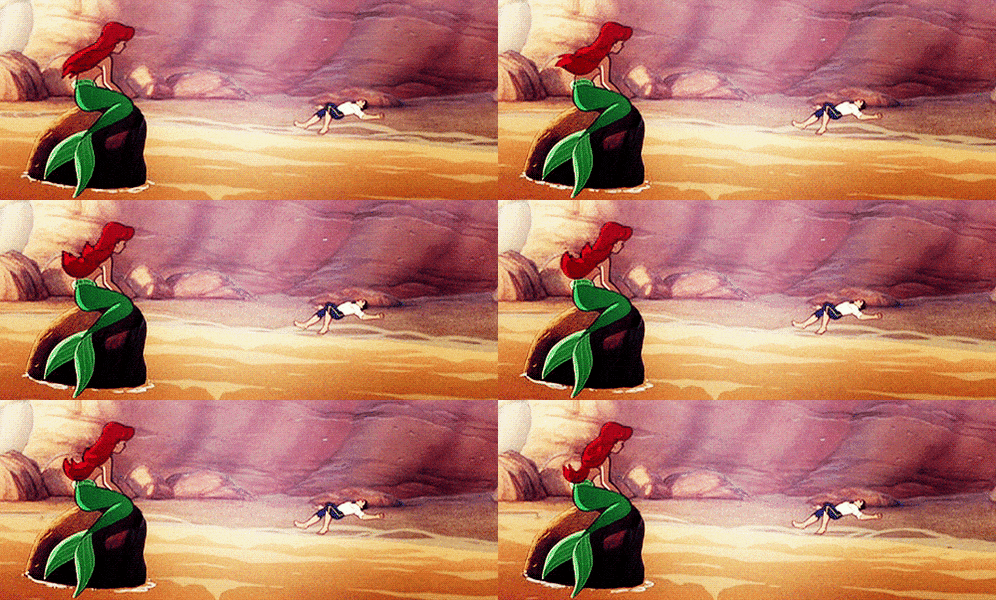
Although after making the deal with the sea witch (again, also unnamed), the Little Mermaid is able to enter the Prince’s court (without a voice - and tongue), but the Prince, over time, confesses to her that he can only love the woman who saved him (and the Little Mermaid, like Ariel, cannot reveal to the Prince that it was she who saved him). However, after being ordered by his father to marry the princess in the neighbouring kingdom, the Prince ultimately has no choice but to give up his search for the young temple maiden.
But, as luck should have it, the princess turns out to be that same maiden, who had merely been staying at the temple to complete her education. However, Disney’s version subtly foreshadows Ariel’s happy ending, when Prince Eric remarks: “Oh she’s out there somewhere. I just haven’t found her yet” while Ariel sits listening below:

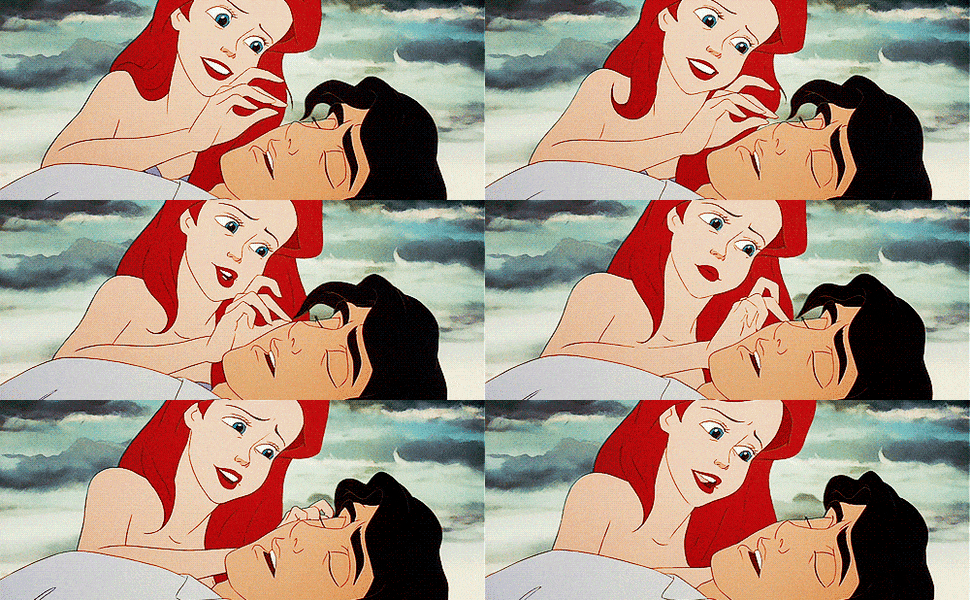
Of course, Disney’s masterful “twist” is Ursula as Ariel’s rival for the Prince (instead of another princess). But we shall come to that soon enough! In Disney's version, instead of a temple maiden, we see Ariel heroically pull Eric to safety and sing to him her promise of one day being 'part of his world'.


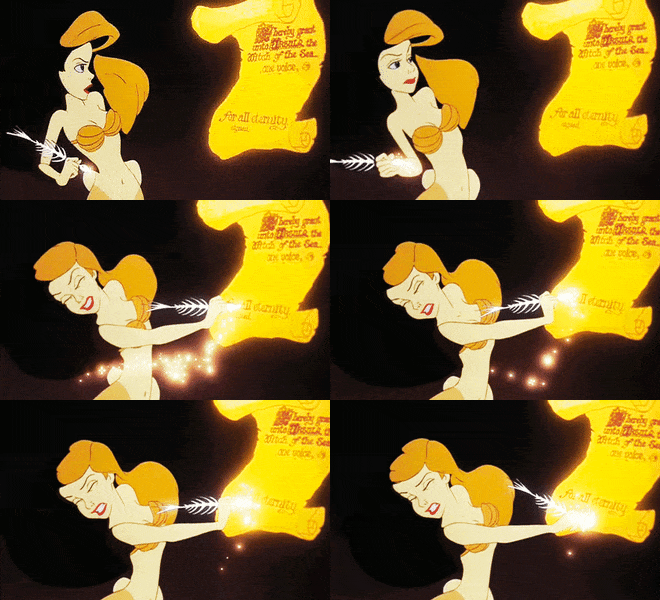
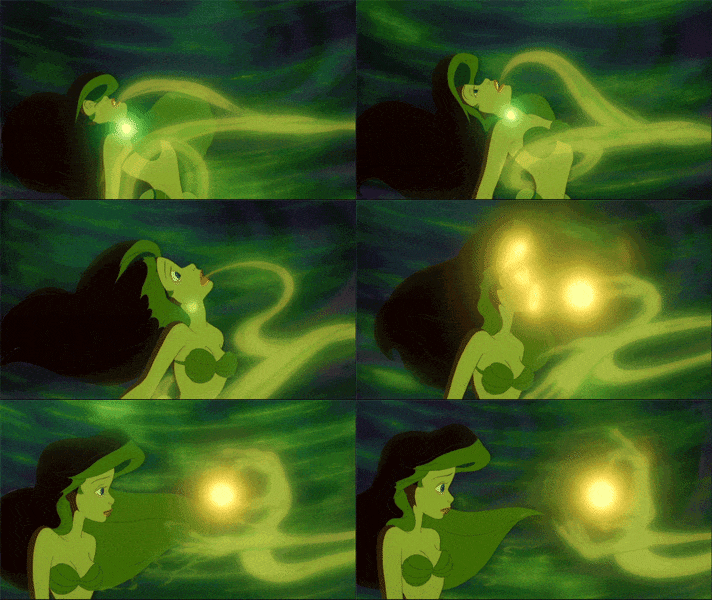
However, this deal will only hold for three days; within these 3
days, Ariel must get the prince to kiss her (that darn true love's kiss clause, again!) or she will return to the
sea and meet the same fate of other merpeople who made a deal with Ursula: being transformed into "living" seaweed!
After accepting the deal, Ariel swims to the surface and meets Prince Eric for the second time. Ariel does her best without her voice to get Eric to fall in love with her by spending much of her time with him during a tour of the kingdom.
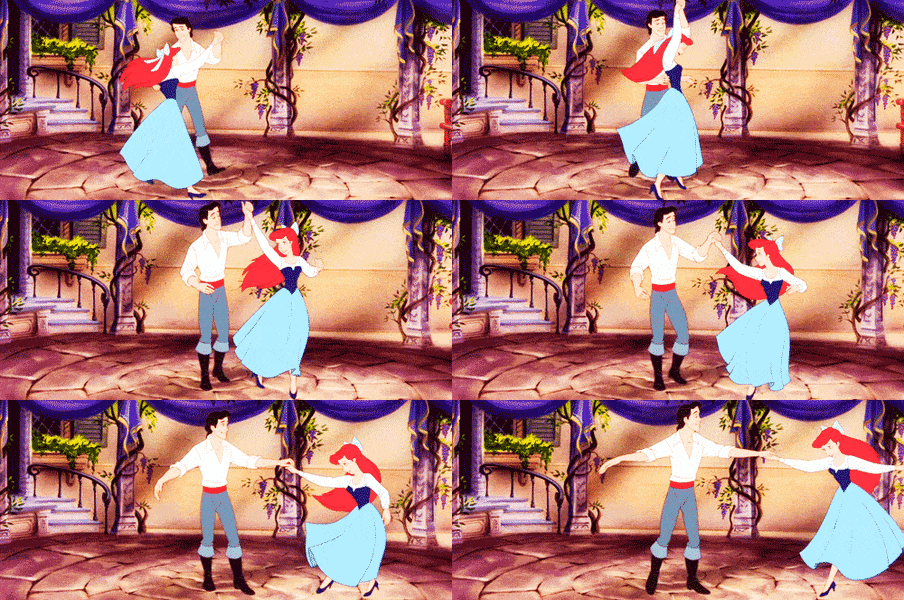
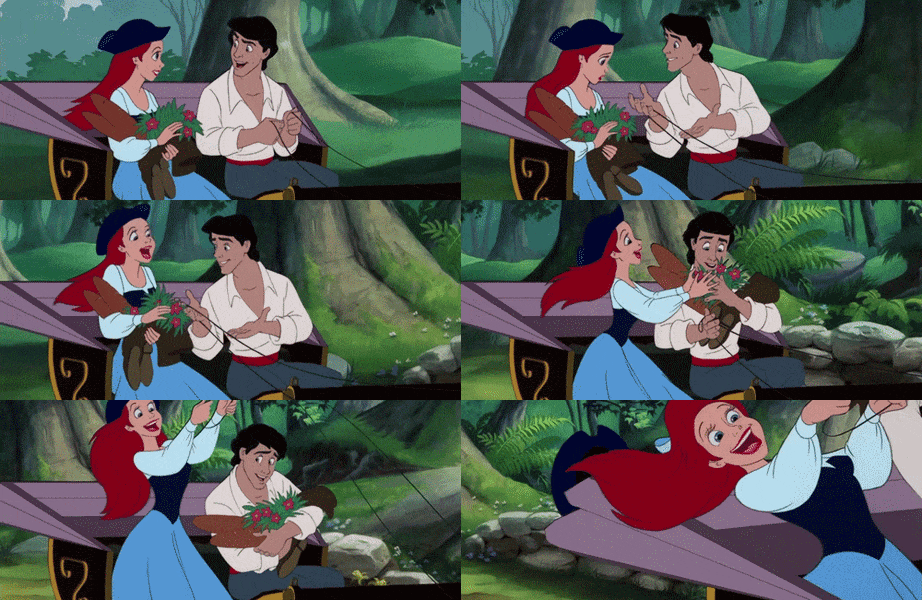
They almost kiss but the moment is ruined by Ursula’s henchmen (or should I say “hench-eels!”) Flotsam and Jetsam. Ursula then transforms herself into a human girl with Ariel’s voice, enchanting Eric to become infatuated with her. The two are set to be married. Ariel soon finds out of Ursula’s treachery and attempts to stop the
wedding. With the help of her friends, Ursula’s nautilus shell that held
Ariel’s voice is broken and returned to Ariel, which breaks the
enchantment on Eric.
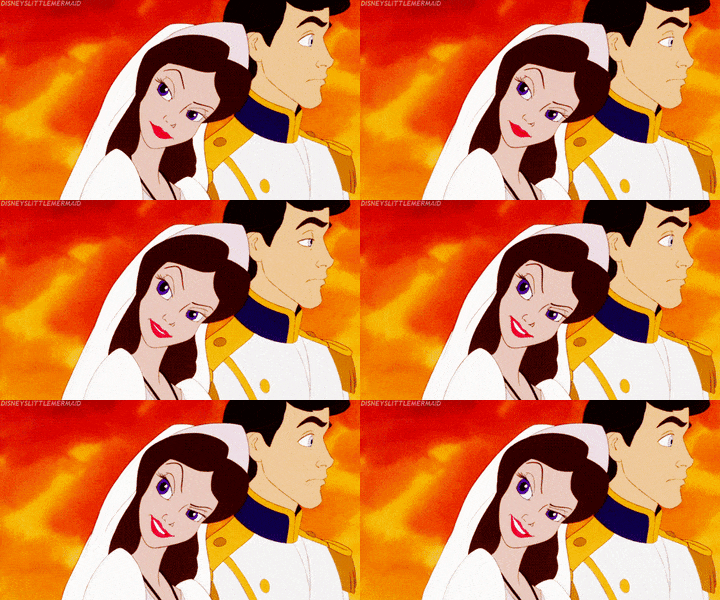
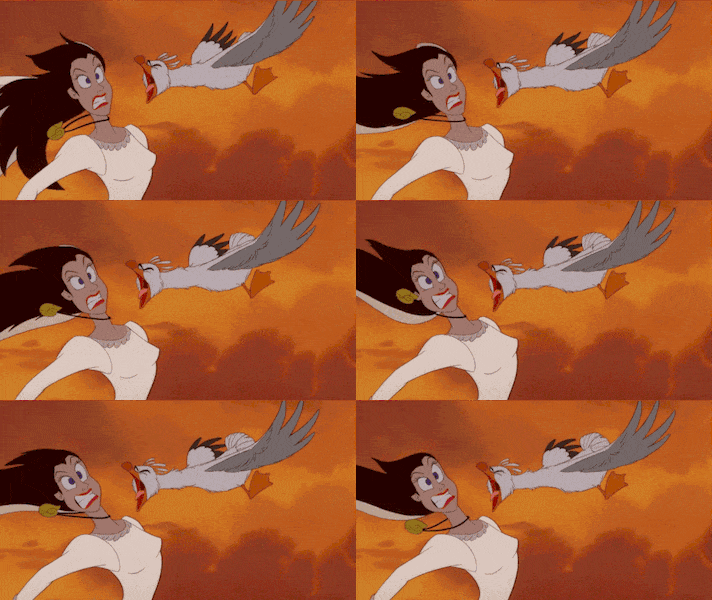
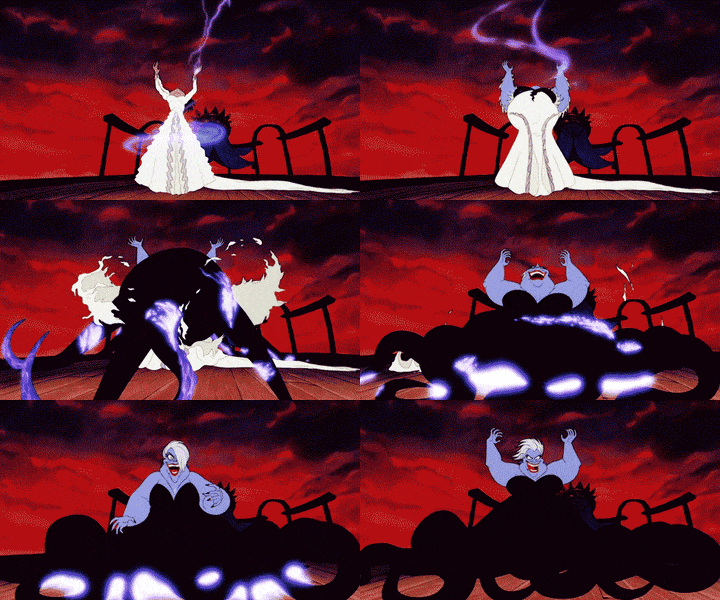
The prince rushes to kiss Ariel, but the sun has set, ending the third day, and Ariel transforms back into her original finned state.
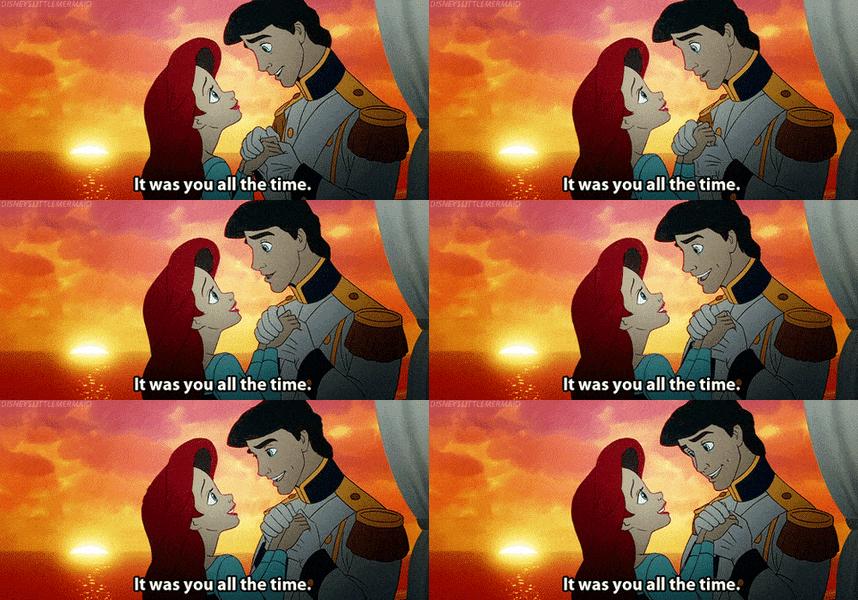
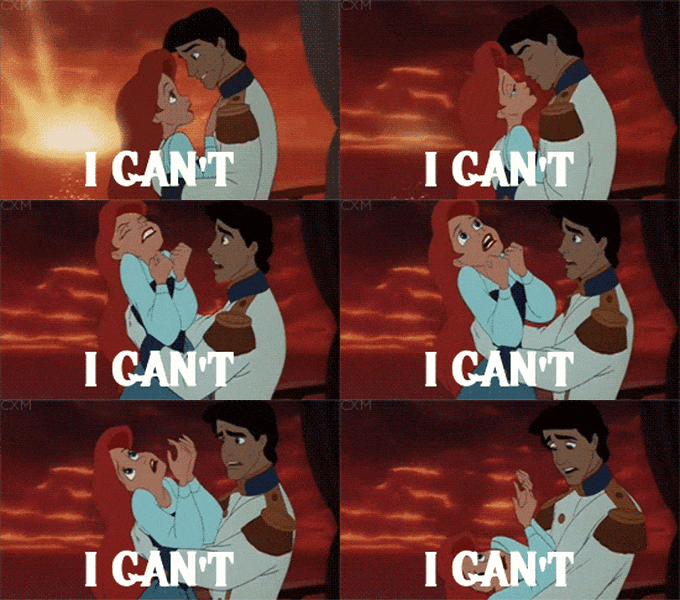
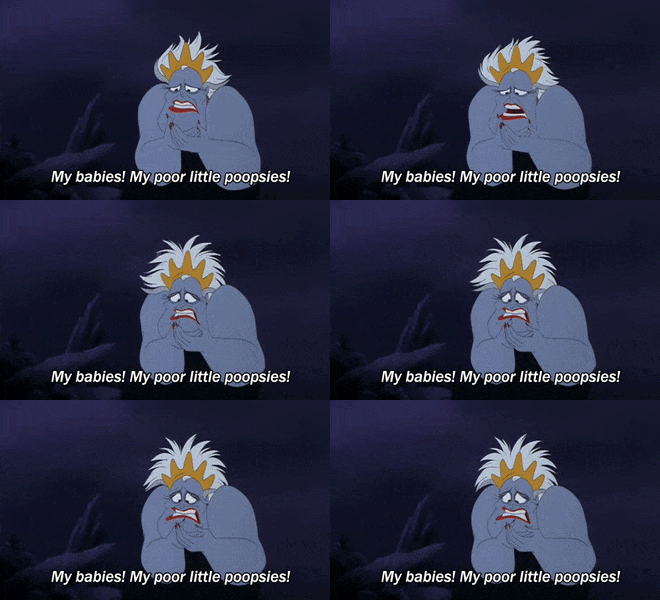 Out for blood, Ursula becomes even more monstrous than before. Eric,
refusing to abandon Ariel to her doom, becomes separated from her, but
not before grabbing hold of a boat that's surfaced due to Ursual's magical whirlpool, and climbing aboard. Before Ursula
destroys Ariel (somewhat echoing Maleficent: "So much for true love!"), Eric impales Ursula with his
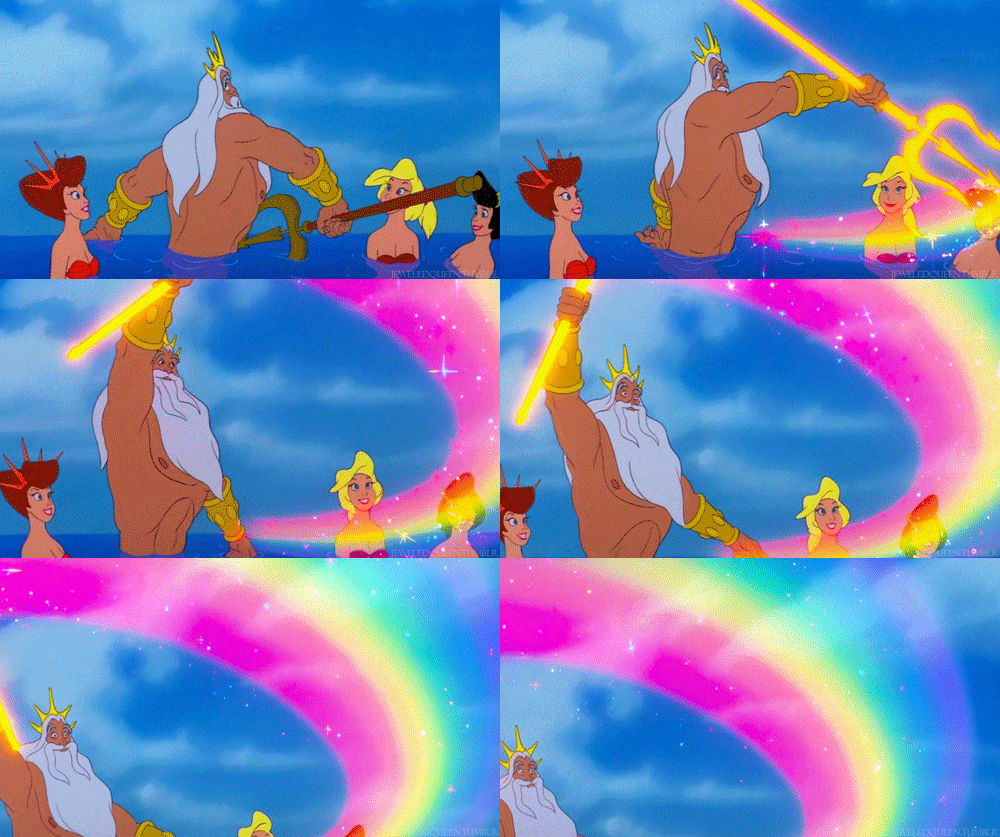
ship, thus breaking all of Ursula's previous spells, transforming every
"plant" (including King Triton) back into merperson once more.
Out for blood, Ursula becomes even more monstrous than before. Eric,
refusing to abandon Ariel to her doom, becomes separated from her, but
not before grabbing hold of a boat that's surfaced due to Ursual's magical whirlpool, and climbing aboard. Before Ursula
destroys Ariel (somewhat echoing Maleficent: "So much for true love!"), Eric impales Ursula with his
ship, thus breaking all of Ursula's previous spells, transforming every
"plant" (including King Triton) back into merperson once more.

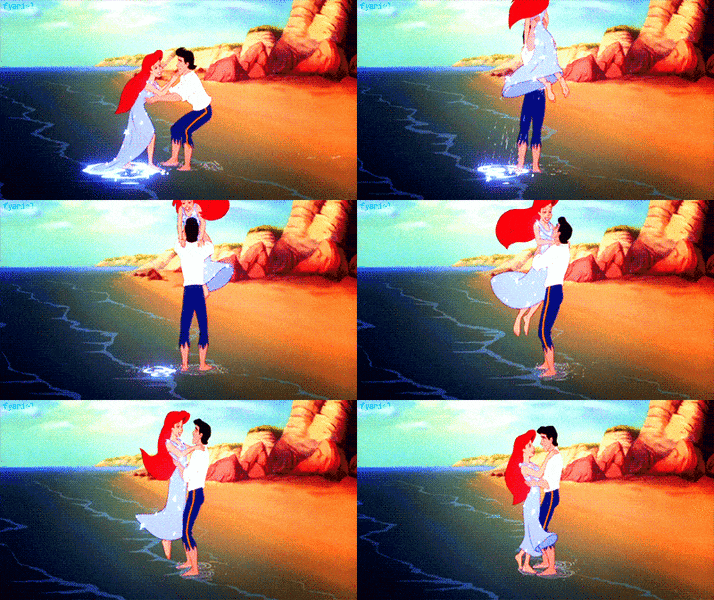
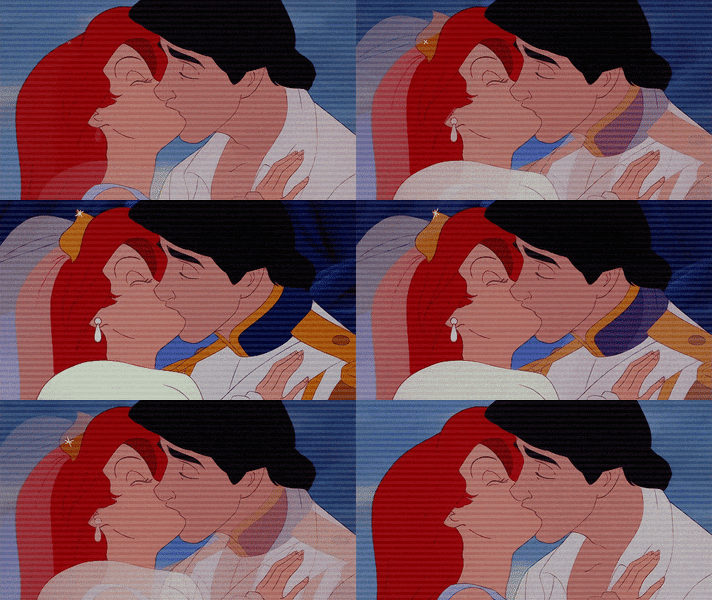
As many of you may know, Disney released a sequel and a prequel to The Little Mermaid. The sequel tells the story of Ariel's daughter, Melody, who is a child of "sea and shore". However, once Ursula's sister finds out about Melody, she swears, out of revenge, to destroy Melody should she ever enter the water. Unaware of her birthright, Melody grows up feeling like a "fish out of water" on land, just as Ariel longed for the shore. Like her mother before her, Melody makes a deal with the sea witch and she transforms into a mermaid. Ariel, with help from her father, transforms back into a mermaid as well in attempt to find her daughter. After years of hiding the truth from Melody, Ariel is finally able to "sing the song of the sea" with her "beautiful Melody".
The prequel, the last of The Little Mermaid films, tells the story of Ariel's childhood, particularly the death of her mother and why Triton forbids there to be any music in his kingdom. It is Ariel, the spitting image of her mother, both in voice and song, with the help of Sebastian, that encourages her father to let go of the past and accept music into his heart once more. This perhaps explains why Ariel's "musical debut" at the beginning of the original Little Mermaid is a very big deal to King Triton.
While Disney sequels are never as wonderful as their originals (The Lion King and Aladdin might be the only two series that make a solid effort in this regard), The Little Mermaid series still offers what the original gave us: a love of the under sea world.
Critical Controversy
While the overall public response to The Little Mermaid was fairly positive, there were many people who strongly disliked the Disney adaptation. Of course, as in the case with adapting books into films, there are going to be differences. Disney did change quite a few details that created a much different story. At first glance, both the fairy tale and the film seem to be about a young mermaid in love with a prince.
However, the stories are about making sacrifices for personal gain. The mermaids in each version are willing to do anything to get something they want. In Andersen's version, the mermaid goes through excruciating pain. She has her tongue cut off so she can no longer speak. To gain legs, she drinks a potion given to her by the sea witch that makes her lower body feel like sharp swords are going through her. When she walks, she feels as if she is walking on daggers. Yet, she still dances for the Prince whenever he asks her, since she dances more beautifully than anyone else. Moreover, when they go on hikes together, despite feeling as though she will collapse, she continues to do whatever the Prince asks her. In Andersen's version, the Little Mermaid's relationship with the Prince appears to be one sided, while in Disney's version, their relationship is more reciprocal.
Many critics believe that, compared to the original tale, Ariel was too vapid of a character by giving up her father and her sisters for an entirely different life. Moreover, in saying how she "just can't see how a world that makes such wonderful things could be bad" suggests, along with her obsessive collection of 'neat stuff', that her view of humans is fairly materialistic (Trites 146). Some scholars even assert that Ariel merely exchanges one patriarchal authority (her father's) for another (Eric's). Disney's version, by portraying Ariel this way, alters Andersen's original intention: Ariel's desire for human form is not representative of her desire for an eternal, transcendental state, but a quest for an identity defined by mortal love (Trites 146).
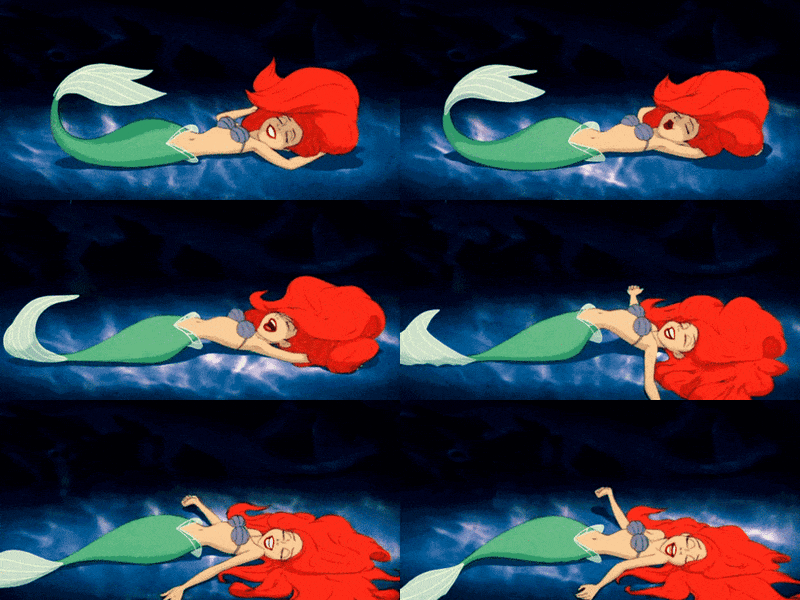 Ariel's love of human culture narrows upon initially seeing Eric. It is no longer enough to be part of the human world; she must win Eric's heart as well. Unlike other Disney princesses, who are immediately the object of the Prince's affection, Ariel pursues Eric, competing against his memory of her singing voice, along with Ursula's enchantment. Although his will is taken from him, Eric's love for Ariel is difficult to distinguish independent of her looks and beauty. Even though Eric enjoys being in Ariel's company, it's only when he realizes it was "her all the time" that his memory of her voice, and her actual person, finally reconcile.
However, despite the initial superficiality of Ariel's and Eric's actions, Disney's The Little Mermaid has much more depth than it seems. Before Andersen's and Disney's mermaid ever see the Prince, their passion for humans is very strong. Disney's Ariel has been collecting human trinkets for what is presumed to be years. She had been longing for another life since she was very young. Meeting Eric only gave her the final push to pursue her dream. Even at the tender age of 16, Ariel thinks and does for herself. While Disney's version frames Ariel's interaction with Ursula as one of borderline coercion (Ursula's "hench-eels" entice Ariel and encourage her to go to the sea-witch), Andersen's Little Mermaid's decision to seek out the sea witch is entirely self-determined. These differences aside, Ariel does not abide by convention, defying all odds in the pursuit of her lifelong dream.
Understanding Feminism, Then and Now
Since the 1980s, the practice of feminism has become more widely discussed and, more importantly, accepted in today's society. Many people, including some celebrities, initially refused to own the label "feminist" simply because they did not understand what it meant to be one. To clear up any misunderstandings: the definition of feminism is the equality between men and women and equal opportunities for everyone. If this is how you feel, regardless of your gender, then you're a feminist! Be proud!
Concerning The Little Mermaid, Ursula makes a number of problematic, non-feminist statements, such as "at least you'll have your man" (as though having a man is the only thing a young woman should care about) as well as the advice that "she who holds her tongue gets her man." She also stresses the importance of Ariel's "looks, pretty face, and [....] body language" (a fairly sexually suggestive statement). The fact that Ursula is saying all of these things clearly indicates that all is not right. However, these statements reflect nineteenth century (and earlier, of course) ideologies regarding gender. In future lessons, such as Mulan, you'll be discussing gender, and feminism, more in depth.
According to Laura Sells, "the mermaid figure becomes both an icon of bourgeois feminism and a sign of the stakes in reinventing the category of 'woman', or re-imagining women as speaking subjects" (177). At the same time, scholars also declare Ariel to be "the very embodiment of consumer-fetishism" on account of her compulsive need to collect objects (Bryne and McQuillan 23). Others even argue that Ariel was modeled after a "slightly anorexic Barbie doll" (Giroux 99), thus portraying a potentially dangerous model for young women. Even her sisters function as "agents of patriarchy" (O'Brien 173) and Ariel's friends are all male. However, scholars agree that The Little Mermaid (1989) was a "turning point" regarding the studio's approach to constructions of gender roles, since Ariel continuously rebels against her father, inspiring to grow both intellectually and independently.
In fact, Ariel may be one of the most ideal Disney feminists. Contrary to popular belief, there are no strict guidelines on how to be a feminist. Feminism is not about the “ideal woman” or going out of your way to challenge all previous notions on gender and femininity. It is about doing what you believe is right for you. Although the King and Sebastian are frustrated by Ariel’s stubbornness, it is this characteristic that drives her to go against the norm in order to live out her dream. Although she had to make many sacrifices, at least she was following her heart.
Ariel made a decision that was difficult, a decision that many earlier Disney heroines would never have to think about making (since it was often the case that a Prince interfered on their behalf). Ariel challenges the "Damsel in Distress" motif; her decisions are entirely her own. It is she who chooses to make a deal with the sea witch and it is her (with the help of her friends) that dares to leave the comfort of all she knows behind. Ariel certainly struggles, but she never gives up on Eric, even when all seems lost.
All of Ariel’s choices are based on her desires. She desires to be part of the human world because she believes, all on her own, that there is more to life on the shores (echoing and anticipating past and future Disney Princesses'- or protagonists' - intense longing for "more"). Although some critics consider Ariel's "desire" as a misplaced motivator, it is important to remember that Prince Eric was the very embodiment of Ariel’s hopes and dreams. He was a link to the life she always longed for. Although she took quite a dangerous risk in "betting" on Eric being "Mr. Right", their gradual courtship, and his willingness to sacrifice his own life to save hers and her father's, suggests that Ariel, in following her heart, made the right call.
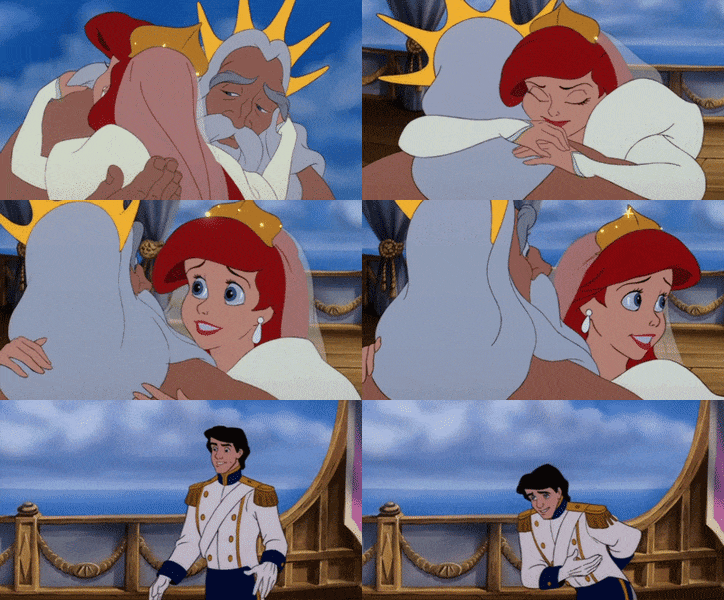
Later in the week, you'll read more about daughters disobeying their fathers in the attempt to follow their hearts!
Merpeople in Reality
Now if you’ve taken Care of Magical Creatures, you will recall from Year 2 that the Ministry of Magic categorizes each creature as either a Being, Beast, or Spirit. Along with this category, they are given a classification (starting from X to XXXXX) that ranks them from least to most dangerous. When considering merpeople, however, these classifications and categorizations do not exactly conform to the standard textbook definitions.

But what are merpeople categorized as? Are they beings, beasts, or spirits?
- Spirits are creatures who are no longer living, such as ghosts.
- Beings are any creatures that have the ability to understand the laws of magic, have the ability to abide by the restrictions of the laws, and have the potential to help contribute to the societal progressions.
- Beasts are defined as creatures that do not have the sufficient intelligence to understand magical laws or help shape society.
These three classifications were officially defined in 1811 by then Minister for Magic Grogan Stump.
From these definitions, you would assume that merpeople fall under the Being category. While they meet all of the requirements to fit the Being status, merpeople actually chose to decline the category and instead moved to be classified as Beasts. The reason for their rejection is because they did not believe it fair to be given the same status as dark creatures such as hags or vampires.

Merfolk also have their own language--Mermish. It can be learned by non-merpeople and it even has a written form. The language itself is very curious as it can only be understood underwater and sounds much like English, although above the surface it sounds like a terrible screeching noise.
As you may recall, Harry found this out the hard way:
The Muggle fairy tales are not always accurate when it comes to magical creatures, but it is always a treat to see a different culture’s perspective on them, especially when the story is so enthralling.
Works Cited
Bell, Elizabeth, Haas, Linda and Laura Sells. From Mouse to Mermaid: The Politics of Film, Gender, and Culture. Bloomington and Indianapolis: Indiana UP, 1995.
Byrne, Elanor and Martin McQuillan. Deconstructing Disney. London: Pluto Press, 1999.
Giroux, Henry A. "Memory and Pedagogy in the 'Wonderful World of Disney': Beyond the Politics of Innocence. From Mouse to Mermaid: Politics of Film, Gender, and Culture. Ed. Elizabeth Bell, Linda Haas and Laura Sells. Bloomington and Indianpolis: Indiana UP, 1995. 43-62.
O'Brien, Pamela Colby. "The Happiest Films on Earth: A Textual and Contextual Analysis of Walt Disney's Cinderella and The Little Mermaid." Women's Studies in Communication 19.2 (1996): 155-183.
Sells, Laura. "Where Do the Mermaids Stand? Voice and Body in The Little Mermaid." From Mouse to Mermaid: The Politics of Film, Gender, and Culture. Ed. Elizabeth Bell, Linda Haas and Laura Sells. Bloomington and Indianpolis: Indiana UP, 1995. 175-193.
Trites, Roberta. "Disney's Sub/Version of Andersen's The Little Mermaid." Journal of Popular Film and Television. 145-152.
Zarranz, Libe Garcia. "Diswomen Strike Back? The Evolution of Disney's Femmes in the 1990s." Atenea. 27:2. 2007. 55-65.
Thank you so much for reading and participating in today's lesson! Tomorrow you'll get to take a journey to a magical castle and learn that appearances really can be deceiving.
You can participate in the discussion on today's lesson here:
https://docs.google.com/document/d/1GXMk0louR5nHh92wzBbxoKcNlFpB7t5SriU4uHHctaQ/edit?usp=sharing
EH
http://www.hogwartsishere.com/emmahart/
https://www.facebook.com/emmaharthih
https://www.facebook.com/HiHMagicalLiterature
-
Poor Unfortunate Students
Essay -
What’s That Word Again?
Essay -
A Quiz: Isn't it Neat?
Quiz -
What the People Know
Essay -
Design a Mermaid!
Essay
