

Lesson 1) (A Miracled Appeared:) The Sword in the Stone
Lesson 1 - (A Miracle Appeared:) The Sword in the Stone
Lesson 2 - Mary Poppins (Practically Perfect in Every Way)
Lesson 3 - (Don't Go Into) The Black Cauldron
Lesson 4 – (But Most of All There’s) Winnie the Pooh
Lesson 5 – (Can’t Wait to Be) The Lion King
Lesson 6 – (The Bells of) The Hunchback of Notre Dame
Lesson 7 – Treasure Planet (The Loot of a Thousand Worlds)
Lesson 8 – "Happily Ever After"
Lesson 9 - Creative Project
Hello everyone! Welcome to Week 2 of Disney Lit Weeks. This week will focus on Disney films adapted from classic literary texts. I am so very grateful to Professor Morgan for her willingness to work with me on this lesson as The Sword in the Stone is very near and dear to my heart.
Before we begin, I wanted to introduce one of the central themes of this week--constructions of masculinity in Disney's films. As you can see by the syllabus, with the exception of Mary Poppins (just like with the exception of Aladdin last week), this week focuses on male protagonists. Last week, we focused on the Princess because this was Disney's focus. The last three films, Princes and the Frog, Tangled, and Frozen was a return to the "Classic" Disney motif and we wanted to properly explore that. However, this week explores masculinity and how Disney's male characters evolved over time. As you may have noticed, in many of Pixar's films, the central storyline focuses on the male characters (with the exception of Brave): Toy Story, Finding Nemo, The Incredibles, Cars, Monsters Inc., Up, and Wall-E.
The transformation of both Disney's female and male characters over time is quite impressive. In today's lesson, we focus specifically on the story of a young boy and his relationship with his older male mentor. More importantly, we explore how a young boy, in the Medieval era, found his place in the larger world. While this lesson doesn't specifically engage with Arthur's masculinity, it is something we would like you to keep in mind when working on your assignments.
Always happy to hear from you!
Emma Hart
http://www.hogwartsishere.com/emmahart/
Lesson 1: (A Miracle Appeared:) The Sword in the Stone
Hello Students! Professors Morgan (of Ancient Studies and Yore Lore fame) and Hart (of Magical Literature and Professor Studies fame) here to talk to you about one of our most favourite Disney adaptations of all time: The Sword in the Stone.
Origins
 In 2013, Disney’s The Sword in the
Stone (1963) celebrated its 50th Anniversary. It was, in fact, the last Disney film released in theatres before Walt Disney's death. The film is based on T.
H. White’s novel (1938) of the same title. Now, White went along and added this novel
into his tetralogy, The Once and Future King, but changed certain aspects
of the story. Indeed, the Disney version much more closely matches that of the
original text, not the edited version; for
example, the second (American) version involved the removal of Merlyn’s (White’s
spelling) “wizard’s dual” with the “Magnificent, Marvelous, Mad” Madame Mim.
In 2013, Disney’s The Sword in the
Stone (1963) celebrated its 50th Anniversary. It was, in fact, the last Disney film released in theatres before Walt Disney's death. The film is based on T.
H. White’s novel (1938) of the same title. Now, White went along and added this novel
into his tetralogy, The Once and Future King, but changed certain aspects
of the story. Indeed, the Disney version much more closely matches that of the
original text, not the edited version; for
example, the second (American) version involved the removal of Merlyn’s (White’s
spelling) “wizard’s dual” with the “Magnificent, Marvelous, Mad” Madame Mim.
The novel's and film's origins derive from one of the most powerful stories ever to be passed down to Muggle and magical families alike: the story of King Arthur Pendragon.
Each interpretation and adaptation of the story of King Arthur is filled with beauty, betrayal, sadness, and ultimately, hope.
In his Preface to the novel, White declares himself to be Sir Thomas Malory’s disciple and heir—Malory being the ‘bard’ of Arthurian legend during the fifteenth century—asserting that he, White, was the author to negotiate “the matter of Britain”. Moreover, White hoped his novel’s moral was not “too heavy” though admits that the story “was always a deep one”.
“After all,” White concludes, “it is the major British Epic” (Sword, i).
It is also important to recognize the perpetual recycling of Arthurian mythology at moments of cultural crisis throughout English history. White’s novel not only responds to the First World War, but also spoke to the oncoming Second World War.
 In this sense, the novel’s story speaks
to an enduring hope for ourselves that humanity can overcome its base nature and follow
a code of honour such as the one followed by the Knights of the Round Table, waiting for the day that just maybe we
will live to see King Arthur rise again.
In this sense, the novel’s story speaks
to an enduring hope for ourselves that humanity can overcome its base nature and follow
a code of honour such as the one followed by the Knights of the Round Table, waiting for the day that just maybe we
will live to see King Arthur rise again.
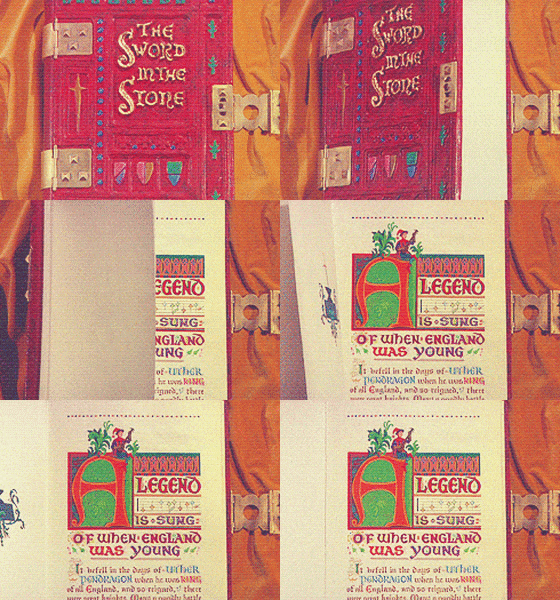
This fragile and precious hope is beautifully depicted in the opening of Disney’s Sword in the Stone—my (Professor Hart’s), favourite Disney opening sequence of all time.

Echoing the ballads of the time in which it is set, the minstrel sings:
“A legend is sung, of when England was young,And knights were brave and bold.
The good king had died,
And no one could decide
Who was the rightful heir to the throne.
It seemed that the land would be torn by war.
Or saved by a miracle alone—
And that miracle appeared in London town:
The Sword in the Stone.”
The camera frame then moves to the image of the sword:
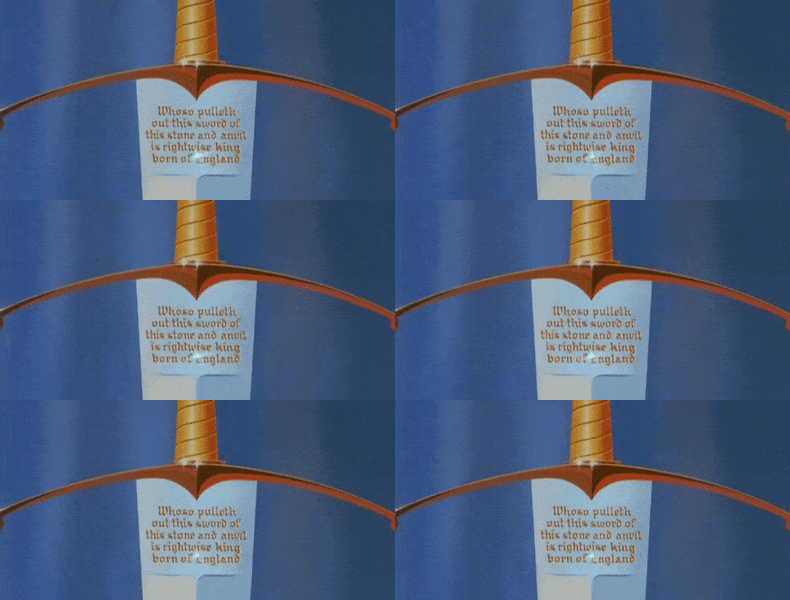
The narrator explains: "Though many tried for the sword with all their strength none could move the sword nor stir it. So the miracle had not worked. And England was still without a king. And in time, the marvellous sword was forgotten. This was a dark age without law and without order. Men lived in fear of one another. For the strong preyed upon the weak."
This opening strikes a stark contrast with the opening of White's novel. In White's novel, the King is still alive and the sword does not appear until six years into the novel's plot--right before Kay becomes a knight, and before Arthur is set to become Kay's Squire. Like the film, the tournament to crown the next King is set for New Year's Day, offering all men the opportunity to remove the sword. It is at this time that Merlyn announces that he will no longer be tutoring Arthur. Merlyn, however, reassures Arthur that they will soon meet again.
These different beginnings evoke different reactions: Disney's version goes right for the suspense and mystery factor: who will pull the sword and when will it happen? However, in White's version, the emphasis is on this seemingly ordinary, "orphaned" boy who gains a wizard for a tutor, a wizard who subsequently disappears when all of England is ripe with excitement and just as quickly reappears when Arthur pulls the sword from the anvil.
In fact, in the 50th Anniversary Blu-ray edition of The Sword in the Stone, Disney studios released never-before-seen storyboards regarding the film's opening. Disney's animators envisioned yet another beginning for the film: http://www.usatoday.com/story/life/movies/2013/08/01/sword-and-the-stone-disney-film-exclusive/2609841/.
Quite different from what they ended up settling on, no? This is not only unique to The Sword in the Stone. If you happen across Disney's Robin Hood (2006 and 2013) Anniversary Blu-ray edition, you'll also discover an alternative ending for the film. Like The Sword in the Stone, it is quite different from the final version!
Although perhaps we (Professor Morgan and Professor Hart), especially as academics, should privilege the literary text above the movie, we still find ourselves sentimentally drawn to Disney's choice in framing of the narrative since it offers a heart wrenchingly poetic and exciting way to approach this widely-depicted subject.
As Disney’s sixteenth full-length animated feature,
The Sword in the Stone remains a
delightful and humorous adaptation of White’s novel, with songs by the Sherman
Brothers (Richard and Robert)—the same brothers responsible for multiple Disney
soundtracks, including Disney’s Mary
Poppins (as we learn from the 2013 screening of Saving Mr. Banks). In fact, this movie was their big debut (though their contributions to Disney's soundtracks increased as their years with the studio went on).
The Story
Disney’s The Sword and the Stone and indeed White’s first volume on which it was based, contains only a small portion of the story of King Arthur; it is the story of his origins: how he comes to know the great wizard Merlin, and how he ends up becoming the King of England. In truth, it’s a very small part of the story - boy meets wizard, wizard trains boy to be virtuous and true, boy discovers sword and becomes king. So what makes this film so special?
As you’ve no doubt heard many times before, the journey’s the thing. It is truly Arthur’s journey (or Wart’s, as he is known throughout most of the film) with Merlin that is the highlight of the film. Through adventures, misadventures, and even a wizards’ duel, Arthur learns all he needs to know about becoming a great king - without learning facts, dates, strategies, or other such information that one would expect a king to know.
What does Merlin teach our young King? Kindness, compassion, duty, understanding, problem solving, and also how to escape a couple of "twitterpated" squirrels.
Ultimately, in a fairly magnificent wizard’s duel, he teaches young Arthur that wisdom and knowledge can easily triumph over power as he defeats Madam Mim by transfiguring into a virus. In the film version, Madam Mim is simply laid up with an illness that will take her a week to recover from. In White’s original version of the story, Madam Mim is killed by the virus, but strangely, the author deleted this entire scene from his updated version of the book that was included in the tetralogy of The Once and Future King.
While Arthur’s education is rather eclectic, it is his interactions with Merlin that enhance his already inherent goodness. Indeed, when Arthur pulls the sword from the stone at the climax of the movie, he simply hands it over to Kay, his foster brother, because Kay needs a sword. He both does not recognize the importance of the sword, nor does he seek its power. Whatever spell was cast upon the sword and stone reminds me of a spell once cast on the mirror of Erised to protect the Philosopher’s Stone - only someone who wanted to find it, not use it, could retrieve the stone. Similarly, it seems the spell cast on the sword and the stone must have only allowed someone pure of heart who was not seeking power to pull the sword. It is Arthur’s good heart that wins him the crown of England, and the lessons that Merlin has taught him will form the basis for how he rules his kingdom.
Merlin
His(tory)
Of all the characters that practice magic in Disney films, Merlin seems to be the practitioner who most closely mimics the magic that we know and practice here at Hogwarts today. Before we examine the magic used in the movie, let’s quickly recap what you have learned about him in History of Magic Y2 from Professors Maddox and Dowler.

We know from the magical feats of Merlin that he was adept at transfiguration and potions, and certainly had some knowledge of divination as he often spoke of the future in regards to King Uther and his son - mostly to warn them of the paths they were on, and, sadly, mostly ignored. We can surmise that Merlin was adept at many other forms of magic, but the one area in which he excelled was by the simple use of logic and shrewdness to work through a situation.
Even though we all like to think of Merlin as an infallible almost super-human wizard, he was, in fact, just as mortal as the rest of us, and was tricked by the Lady Vivien into being trapped in a cave. Most wizard historians agree that Merlin escaped these caves, but was injured in some way that reduced his magical prowess, as he never returned to the service of a king. I (Prof. Morgan) often wonder myself if Merlin simply was too brokenhearted after the loss of Arthur to continue aiding kings any more.
While fragments of Merlin’s story can be traced back as far as the 1100s—for example, Merlin Calidonius (Welsh prophet Myrddin Wylt mab Morfryn) and Merlin Ambrosius (prophet in Geoffrey of Monmouth’s Historia Regum Britanniae)—his full story originates from the Old French and Middle English Arthurian romances of the thirteenth to fifteenth centuries. For example, Sir Thomas Malory’s Le Morte D'Arthur (1485) takes up Merlin’s narrative, a narrative that many nineteenth century Victorians, including Alfred Lord Tennyson’s Idylls of the King (1859–85), drew on in their own work.
Although the legend (and for us, the reality) of Merlin has existed for
more than a thousand years, the current perception of the character is based
predominately on his portrayal in Disney’s version and in its source, White's novel.
Merlin as Teacher – “You can’t grow up without a decent education, you know.”
If we compare the Merlin of history to the Merlin of the Disney film, we can certainly see some strong similarities, particularly in Merlin’s role in relation to Arthur (“The Wart”), as well as his use of magic.
Although it is not clear how they get “Wart” from “Arthur” in the film, White’s explanation of it in the novel is bitterly comic (though we’ll explain why this is at the end of the lesson). In the novel, White explains: “The Wart was called the Wart because it rhymed with Art, which was short for his real name. Kay had given him the nickname (White 7). Even in the novel, it is not immediately made clear that the Wart’s “real name” is Arthur, nor is it initially made clear about his true identity, similar to Disney’s version. In the film, we aren’t entirely sure what Arthur’s position in the castle actually is; yet, according to White’s novel, Sir Ector is the adoptive father of Arthur, subsequently making Kay Arthur’s adoptive brother (of sorts). In the film, when Arthur is initially missing, we learn that Sir Ector “adopted the boy” and appears to be genuinely worried about the boy’s whereabouts, having learned from Kay that Arthur went off into the woods by himself.
Unlike the film’s introduction of the mention of the sword, the novel opens with Kay and Arthur, having just finished their work in the fields, decide to go hawking. Even though Arthur is better with the hawk (named Cully), Kay insists on carrying it. Releasing the hawk prematurely, Kay loses the hawk. Demonstrating his carelessness, Kay refuses to go after the bird. Arthur worries that the bird’s caretaker, Hob, will be disappointed if his training of Cully goes to waste.
Alone (like the film), Arthur goes wandering
in the Forest Sauvage (“Savage”) in search of the hawk (instead of the film’s
arrow) and happens across the cottage belonging to “Merlyn”—a wizard who was,
as he informs Arthur in the novel, “unfortunately…born at the wrong end of time”
who must “live backwards from in
front, while surrounded by a lot of people living forwards from behind” (White
48).
We are also told that Merlyn has the gift of “second sight” (40), which is depicted more clearly in the film:

As Merlin heads with Arthur back to the castle to become the boy’s official tutor, Arthur exclaims “What a way to pack!” to which Merlin almost immediately responds testily, “Don’t you get any foolish ideas that magic will solve all your problems. Because it won’t!”
This is something that we’ll discuss further in Magical Literature come Year 4!
Having seen well into the future, Merlin is all about “higher learning”. For Arthur, who knows very little of the world, much less the world of the future, cannot imagine anything more glorious than being a Squire.
In fact, the very notion of “rising” was something almost unheard of, especially in the Medieval Ages. From then and well into the nineteenth century, the position you were born into was the position you would essentially hold for the rest of your life. Opportunities for advancement were scarce, unless you had access to money, and more often than not, very few did.
Certainly Merlin was a man ahead of his time, which is why, despite Arthur’s potentially limited options, Merlin informs Arthur that:
“…even in these bungling, backwards, medieval times, you have got to know where you’re going. … You must plan for the future, boy. You’ve got to find a direction!”
Given that Year 4 is just around the
corner, we certainly hope that you’ve been thinking about your
“directions” both online and off! As someone who is a big fan of teaching, I sincerely hope you've blocked off your schedules for Professor Studies!
Yet Merlin knows that, for a boy of Arthur’s age, it will be very difficult to ‘win him over’ to his own view of things. Which is why, as he informs Archimedes (Merlin’s ‘highly educated owl’) that he intends to “cheat” (use magic – “every last trick in the trade!”) to convince Arthur that education is the way to go.
Merlin as (Instructive) Magician
In the film, Merlin is both a “soothsayer” and a gifted magician. When asked by Sir Ector if Merlin ever goes for any of that “Black Magic”, Merlin reassures him by saying, “No, never touch the stuff. My magic is used mainly for educational purposes”—precisely why he arrives at the castle with Arthur, looking to become the boy’s tutor. Whereas Disney’s version depicts Sir Ector as being resistant to Merlin’s interference, White’s novel begins with Sir Ector looking for a tutor for the boy, whereupon Kay becomes jealous of Arthur’s numerous adventures.
In his quest to instruct Arthur, Merlin frequently uses transfiguration: Arthur is transfigured into a perch (fish), a squirrel, and a bird. In White’s version, Arthur is also turned into a number of other creatures (including a hawk, an ant, an owl, a wild goose, a snake, and a badger). However, the lessons Arthur learns in Disney’s version are somewhat of a far cry from those he learns in the novel (though still important nonetheless).
“Brains over brawn” (That’s What Makes the World Go ‘Round)
Before Merlin transfigures Arthur into a fish, Arthur expresses his wish to become a knight: “I’d give anything to go riding about on a great white charger, slaying dragons, griffins, and man-eating giants.” Arthur’s wish actually echoes some of the activities Arthur and Kay get up to on their various adventures in the novel.
While Disney’s version separates Arthur and Kay by both personality and age, White’s version states that Arthur is merely one year younger than Kay. White showcases Arthur’s good-nature by asking Merlin why he frequently ignores Kay. Acknowledging Arthur’s wish to include Kay, Merlin assures Arthur that Kay will have an adventure as well.
This is where Arthur and Kay meet Robin Wood (known to his companions as “Robin Hood”) as well as Maid Marian. Robin Hood informs the boys that Friar Tuck has been kidnapped by Morgan le Fay, a woman they believe to be the Queen of Fairies.
As Merlin promised, Kay is the hero of the day: he helps rescue Friar Tuck, saves Arthur from being killed by a griffin, and cuts off the griffin’s head, a symbol of his victory. To further emphasize the difference between them, while Kay revels in his glory, Arthur’s only concern is for Wat (the “local idiot”) and wishes to bring Wat to Merlyn in order to “cure” him of his madness. Another adventure for the two boys includes battling a giant, but this didn’t make it into Disney’s version.
Arthur’s kindness appears to stem from his intelligence: his belief that everyone should be treated equally and fairly. When Merlin transfigures Arthur into a fish, he eventually gets Merlin’s “point” about “brain over brawn”:
The message is important, yes, but only a small part of the overall lesson that White wishes to impart. Novel-Arthur learns something far more integral to his eventual rise to kingship—the dangers of absolute monarchy. The large pike that Arthur, as a perch, manages to escape from (with the help of Archimedes) in Disney’s film is actually the “King” of the moat in White’s novel. The King Pike tells Arthur that Power and Might are the only two things worth living by—and then attempts to eat Arthur before Merlyn transfigures him back into a boy.
Later on in White’s novel, Arthur is transfigured into an ant, where he learns the exact opposite: the dangers of communism and the problematic subversion of the individual will for the greater good, which is a stark contrast to the goose colony Arthur enters, which exemplifies a kind of democratic socialism.
“Look Before You Leap” (A Most Befuddling Thing)
Arthur’s lessons continue, in Disney’s
film, during his time as a squirrel. Arthur learns to ‘look before he leaps”
and, perhaps most important of all, that love is the most powerful force on
Earth.
Merlin: “That love business is a powerful thing.”
Arthur: “Greater than gravity?”
Merlin: “Well, yes, boy, in its way. … Yes, I’d say it’s the greatest force on Earth.”
Echoing Merlin, Dumbledore too believed that love had the ability to conquer all evil. It was Harry's mother’s love that saved Harry’s life as baby, and it was Severus Snape’s love for Harry’s mother, Lily, that ensured his unwavering devotion to protecting her son until the very end. Besides the opening of The Sword of the Stone, this moment of the film cuts me (Professor Hart) to the quick: the image of the female squirrel watching Arthur walk away is a startling reminder of the fragility of any heart and that we should always “look before we leap” into anything involving our hearts.
While Arthur is punished (with demerit points) for being gone so long and making up “Big Fish” stories the first time he returns home late, things escalate rather badly for Arthur the second time, when Sir Ector and his kitchen staff witness Merlin’s (rather impressive) cleaning spell. Rushing to Merlin’s defense after Merlin disappears in a huff, Arthur vehemently declares, through tears:
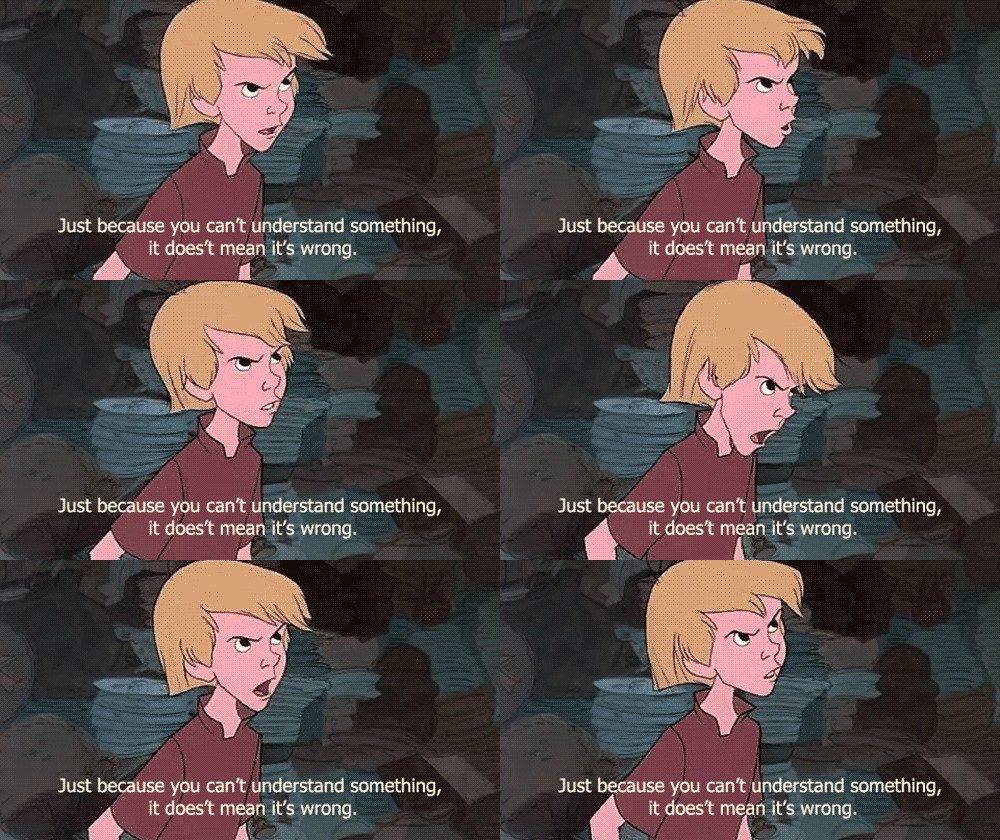
As punishment, Arthur loses his opportunity to be a Squire and his heart is most clearly broken:

Yet all is not lost! After all, Arthur still has his lessons with Merlin, though Arthur is still not entirely sure, as he tells Merlin, what “good” an education will do for him.
Unfortunately for Arthur, Merlin has learned everything “backwards”, and attempts to teach him future-oriented thinking. This, of course, gets on Archimedes’ very last nerve (who has, up until this point, mostly stayed out of the boy’s education):
“Man has always learned from the past. After all, you can’t learn history in reverse! It’s confusing enough for heaven’s sakes.”
Merlin, in a huff (as usual), hands Arthur’s education “over” to Archimedes. The owl asks Arthur to read “a mountain of knowledge” only to discover that the boy cannot read or write. While learning his ABCs, Arthur becomes distracted by Merlin frantically searching for his “flying contraption”. Staring longingly out the window and imagining himself to be a bird, Merlin transfigures Arthur one last time: into a bird (in White’s novel, Arthur is transfigured to at least four different birds: a “merlin”—a type of hunting bird— a goose, a hawk, as well as an owl).
Archimedes and Arthur then go flying. Arthur, of course, appears to be a “natural” (symbolic of his future elevated status and success, no doubt). The appearance of the hawk, like Arthur’s earlier mention of the griffin and giant, is a clear reference back to White’s novel. This ultimately leads to Arthur’s introduction to “Mad” Madame Mim. When Merlin shows up to rescue Arthur, Merlin and Mim enter into a “wizard’s dual”: http://www.cornel1801.com/disney/Sword-Stone-1963/film7.html.

To finally drive his point home to Arthur, Merlin wins the dual by becoming a rare disease that Mim “catches”, proving that “knowledge and wisdom is the real power.”
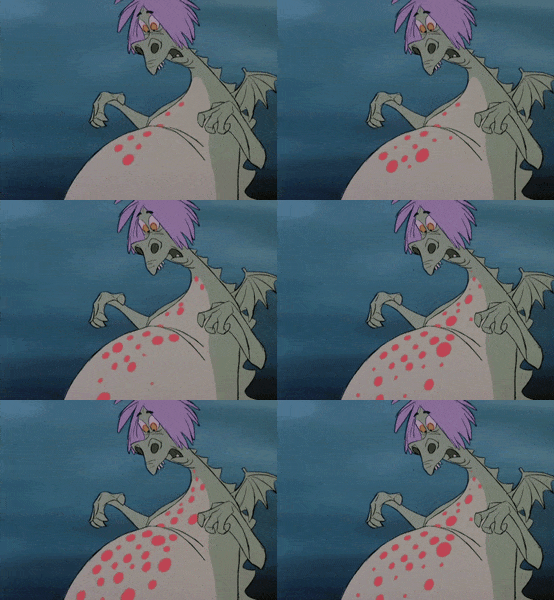
An interesting thing to note, regarding
the background music when Mim emerges as a fire-breathing purple dragon, is
that it clearly echoes that of Maleficent's music in Sleeping Beauty (as well as the castle burning scene in Robin Hood). Be sure to pay attention to this the next time you watch these films!
Merlin’s temper: The Final Catalyst
In both real life and in the movie, Merlin becomes quite annoyed with Arthur at different periods of his life and disappears at a critical moment. Sometimes this works out, as when in the film Arthur pulls the sword from the stone. Other times it is possibly Merlin’s absence that is Arthur’s downfall, perhaps most greatly demonstrated by his advisor’s absence at the battle where Arthur is defeated and carted off to Avalon, hopefully to be healed by the Lady Morgana.
In Disney’s version (as well as White’s), Merlin loses both his temper and his patience throughout, often resulting in Arthur’s punishment (additional chores), or the complete abandonment of his pupil altogether.
In the film, we see months have passed since Arthur first meets Merlin (in July) and it is now Christmas. “Young Hobs” (his novel-version mentioned earlier on in the lesson), has come down with the mumps. The duty of being Kay’s Squire now falls to Arthur once more. In his excitement, Arthur rushes to Merlin to share the good news. Merlin, of course, is less than pleased, referring to Arthur’s get up as a “monkey suit”. Arthur, not quite understanding Merlin’s point, responds, “It’s what all Squires wear…”.
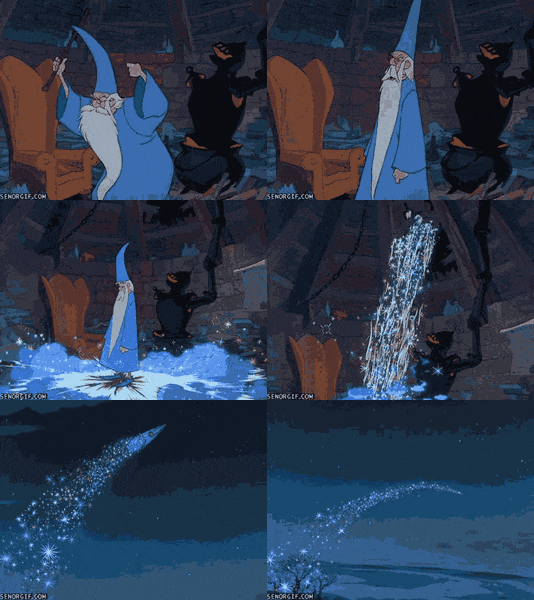
Merlin loses his temper, angrily remarks, “And I thought you were going to amount to something!” and subsequently kicks over his globe and books. Arthur does not take well to Merlin’s anger, sheds a few tears, and sadly declares that he’s “nobody” and “lucky to be Kay’s Squire”. Instead of comforting Arthur, Merlin just loses it altogether. Despite being one of the most powerful and wise wizards of the age, Merlin certainly could stage quite the dramatic exit (and entrance, for that matter). Shouting “Blow me to Bermuda”, Merlin shoots off like a rocket, leaving Arthur and Archimedes to fend for themselves.
White's "Bitter Comedy" Explained
Arthur, with Sir Ector and Kay, go to London for the tournament. In all the excitement, Arthur forgets Kay's sword.
Leaping into action, Arthur attempts to pull the sword from the stone. In typical Disney style, we hear a choir and see the magical twinkling (again echoing the animation of Sleeping Beauty and the fairy's gifts) of Arthur's impending apotheosis (elevation to divine status). In comedic fashion, Archimedes tells him to leave it alone.
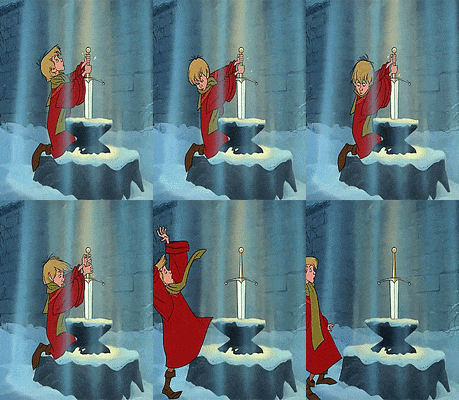
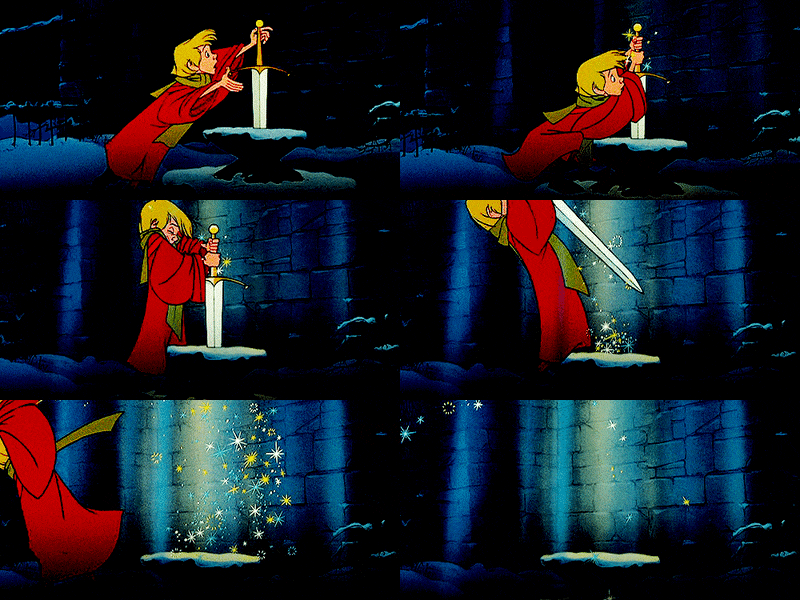
In frustration, Arthur exclaims, "But Kay's got to have a sword!" and smoothly pulls it from the stone.
In White's version, when Arthur returns with the sword, Kay lies to his father and says that he retrieved it, but his father sees through his lie. In Disney's version, Sir Ector doesn't believe what Arthur says (because no one does!) and so the tournament is put on hold and everyone returns to the anvil.
And here we come to White's bitter comedy:
Although Disney's version does not discuss it, "The Wart" is an illegitimate child. In White's version, we learn that Arthur is, in fact, King Uther's son (the product of the illicit tryst between the King of England and Igrayne, a union only made possible by Merlyn's magic). Arthur's nickname Art to "Wart" suggests the idea of England as an unsightly growth of dead scar tissue. Ultimately, the nickname serves as a reminder that England's national identity is not as "conventional" or as "ideal" as many Britons initially wished it to be. They (Britons), in fact, come from very humble origins (a trope seemingly derived from many biblical stories).
Finally, everyone acknowledges Arthur as King:
When Arthur pulls the sword from the stone, it has to be, by far, one of the most iconic moments in Disney cinematic history. For me, Professor Hart, I get chills every single time I watch it. Arthur is "ordained by heaven" to be the rightful King of England. Although in history, the "Divine Right of Kings" implied that a King automatically was "ordained" by heaven to rule on Earth, the miracle of the sword placed Arthur above any King before or after him in all of history.
The most telling moment is when Sir Ector tells Sir Kay to "bow to your King".

When Kay looks up briefly at Arthur, his face suggests a kind of epiphany. Perhaps Kay, all along, knew in his heart that Arthur possessed the true makings of a King and in this moment, is properly humbled by him. Amazing what a single glance can reveal!
The End?
Arthur, now the King, has absolutely no idea what to do. The narrator's lofty "and the glorious reign of King Arthur had begun" strikes a comedic contrast with Arthur's depressed expression (and the crown being too big for his head).
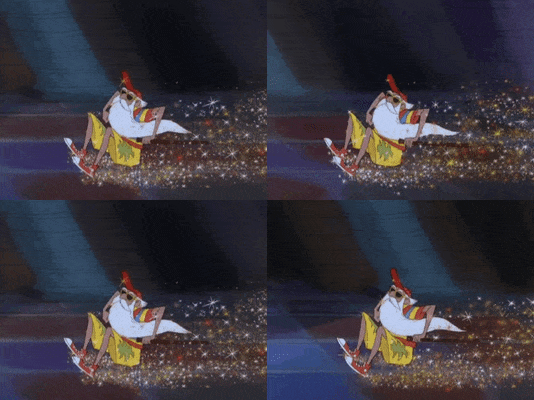
Desperate to leave, Arthur attempts to escape from all sides of the castle. Trapped and feeling utterly alone, Arthur calls out for Merlin. To his (and our) surprise, Merlin returns (making his usual dramatic entrance)!
When thinking back to this moment while reading Harry Potter and the Goblet, I (Professor Hart) was struck with an amusing parallel: "As for informing the headmaster, Harry had no idea where Dumbledore went during the summer holidays. He amused himself for a moment, picturing Dumbledore, with his long silver beard, full length wizard’s robes, and pointed hat, stretched out on a beach somewhere, rubbing suntan lotion onto his long crooked nose."
Perhaps Dumbledore and Merlin really did have a lot in common!
Hilariously commenting that you (really, us) can "have" the twentieth century, Merlin declares our current time to be "one big modern mess" (an explicit reference back to the beginning of the film - can we ever be happy in our own time?) and is quite relieved to be back.
Arthur exclaims, "I'm in an awful pickle; I'm King!"
Pleasantly surprised, Merlin now realizes that Arthur is that Arthur, whereas in White's version, Merlyn knew all along and had 'staged' the whole thing. White's version depicts Merlyn as far more serious in this moment (Merlyn actually appears when Arthur pulls the sword), remarking to Arthur: "I know the sorrows before you, and
the joys [ . . . ] there will never again be anybody who dares to call you by
the friendly name of Wart. In future it will be your glorious doom to take up
the burden . . . of your proper name [ . . . ] my dear liege lord, King Arthur."
This, of course, would be out of place in Disney's version, given it's light-hearted tone throughout.
Instead, Disney's version provides a "meta" self-referential point to the fact that Arthur's story is one that has been told many times. Merlin concludes the film by saying to Arthur: "You'll become a great legend. They'll be writing books about you for centuries to come! Why they might even make a motion picture about you."
Adding to the humour, he then goes on to explain that a motion picture is "like television, but without commercials" which really drives home the fact that we really have, in fact, been telling Arthur's story for centuries.
ABC's Once Upon a Time recent season finale actually ends with setting up the next season with the group's search for Merlin, the answer to all their problems. On account of this, and many other recent or future adaptations, Merlin's story will no doubt continue to be told for centuries to come.
A Story for the Ages
It is hard to discuss the story of King Arthur without wondering why it remains one of the most potent and beloved stories of the age. It has been passed down through generations, rewritten and interpreted dozens of times (perhaps hundreds), and never seems to lose its potency as a tale of chivalry, love, magic, and betrayal. Perhaps it is our love for the dream that Arthur has of a perfect kingdom with a shared leadership with his Knights, or perhaps it is the tales of forbidden and tragic love. Perhaps it is all or none of these things. The truth is that this story still resonates with many of us - and many of us hope that Merlin was correct; that Arthur, the Once and Future King, will rise again to lead us when we need him the most.
"Hail! King Arthur! Long Live the King!"
Works Cited
Jackson, Aaron Isaac. “Writing Arthur, Writing England: Myth and
Modernity in T.H. White’s The Sword in
the Stone.” The Lion and the Unicorn:
33. 1. 2009. 44-59. Online.
Torregrossa, Michael. "Merlin goes to the movies: the changing role of Merlin in cinema." Film and History. 29: 3-4. 1999. 54-65. Online.
White, T. H. .The Sword in the Stone. London: William Collins Sons, 1976. Print.
We hope you enjoyed the first lesson of Disney Lit Week 2! It's been such a pleasure putting this all together and I hope you stick around with us for the remainder of the ride. In a few days, you will hear from Professor Morgan again, as she will introduce you to one of Disney's lesser known films, The Black Cauldron.
If you would like to discuss today's lesson, please go here:
https://docs.google.com/document/d/1kBvL3TLPndbQOT7zeMAs_cB_9iR-RYvZiMfPXp4Z8SI/edit?usp=sharing
EH
https://www.facebook.com/HiHMagicalLiterature
https://www.facebook.com/pages/Professor-Studies-Track/491893090968681
